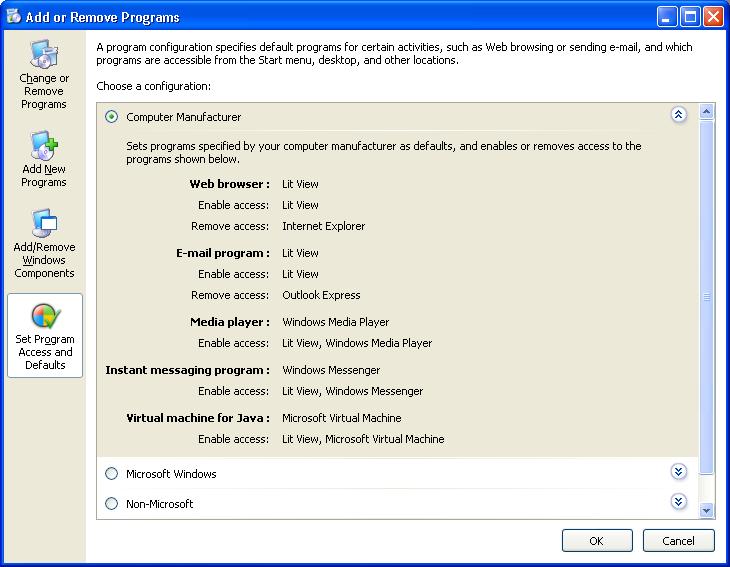
Hkeylocalmachine Software Clients Mail Default Program Associations
This topic includes the following sections. • • • • • • • • • • • • • • • • This topic extends existing documentation about registering a program as a particular client type. For links to that documentation, see the Related Topics section. Common Registration Elements for All Client Types When registering a program as a client type, most of the registry entries are the same regardless of the client type. Some registry entries, however, are specific to the client type and these are noted in the section. This section discusses the following topics: • • • • •.
Please run Microsoft Outlook and set it as the default mail client. Also, click the first option in the list, which is Set your default programs and reset your mail client there, in addition to the. HKEY_LOCAL_MACHINE SOFTWARE Clients Mail. To configure the default e-mail client using Group Policy, create a custom.adm template. Then, add this. HKEY_LOCAL_MACHINE Software Clients Mail The name of. Set a default associations configuration file.
All client type registration information is stored under the following subkey: HKEY_LOCAL_MACHINE Software Clients ClientTypeName ClientTypeName is one of the following subkey names: • StartMenuInternet (for browsers) • Mail (for email) • Media (for media playback) • IM (for instant messaging) • JavaVM (for virtual machine for Java) Throughout this topic, you will note references to a fictional computer program named 'Lit View' by Litware Inc., with an executable file named Litview.exe. This hypothetical program is used interchangeably as an instant messenger, a browser, or another type of client program as needed for illustrative purposes. Selecting a Canonical Name The vendor must choose a canonical name for the program. The canonical name is never shown to the user, so it does not need to be localized. Its only purpose is to provide a unique string that can be used to identify the program.
Elekta service agreement options help maximize clinical availability and utilization for all solutions in the Elekta portfolio — including Leksell Gamma Knife ®, oncology solutions, brachytherapy, MOSAIQ ®, and treatment planning. If you have your own in-house support or prefer to pay for service on a parts-and-labor basis, a Silver level agreement provides a minimum level of coverage for reliable efficiency at competitive pricing. Because service agreements differ depending on the specific Elekta solution, we have developed tiers that represent various levels of coverage to better support your needs. Eltex alatau puljt instrukciya.
It is typically the same as the English name of the program, but this is merely a convention. For client types other than browsers, the canonical name can be any string. Choose a unique name, one that is not likely to be used by another vendor. For browser clients, the canonical name must be the name—including the extension—of the associated executable; for instance, 'Litview.exe'. Here are some examples of canonical names. • Iexplore.exe (browser) • Windows Mail (email) • Windows Media Player (media) • Windows Messenger (instant messaging) Register the canonical name by creating a subkey as shown here. The name of the subkey is the canonical name.
All information relating to that program's registration will exist under this subkey. HKEY_LOCAL_MACHINE Software Clients ClientTypeName CanonicalName Registering a Program's Display Name The next step in registration is to specify the program's display name. It is given as a value under the canonical name key as shown here.
Note again that CanonicalName and ClientTypeName are not the actual names of the keys, but only placeholders for the true names, such as Lit View. HKEY_LOCAL_MACHINE Software Clients ClientTypeName CanonicalName LocalizedString = @FilePath,-StringID The LocalizedString value is a REG_SZ string and consists of an 'at' sign (@), the full path to a.dll or.exe file, a comma, a minus sign, and a decimal integer. The decimal integer is the ID of a string resource—contained within the.dll or.exe file—whose value is to be displayed to the user as the name of this client. Note that the file path does not require quotation marks, even if it contains spaces. Registering the display name string in this manner allows the same registration to be used for multiple languages. Each language installation provides a different resource file with the display name stored at the same resource ID. The following example shows the registration for a fictional Lit View instant messaging program.
Because it is an instant messaging program, the CanonicalName subkey (in this case Lit View) is stored under the IM subkey. HKEY_LOCAL_MACHINE Software Clients IM Lit View (Default) = Lit View LocalizedString = @C: Program Files LitwareInc ResourceDLL.dll,-123 Note the use of the (Default) entry as a secondary declaration of the client's display name. If the LocalizedString is not present, the (Default) value is used instead. This works with all client types (Internet browsers, email browsers, instant messengers, and media players).